The Five Phases of AI Adoption, and Why the Next One Changes Everything

I just came across this chart recently and it really put things into perspective. Most people in the world have not even interacted with an AI chatbot yet, so it does make me rethink the pace that things will change.

We talk about AI adoption as if it is one event. A switch that flips. But the reality, for anyone who has lived through it inside an organization, is that AI adoption unfolds in phases. Each one feels transformative while it is happening, and then feels obvious in hindsight once the next phase arrives.
Most organizations are still operating in the early phases. The truly disruptive shift has not happened yet. And when it does, it will not just change how we work. It will change who is in charge.
Phase One: Glorified Search
Before AI, we had Google. Google was not bad at finding information. But it handed you ten blue links and left the rest to you. You had to click through results, take notes, synthesize across sources, and produce your own final answer. The intelligence was in the finding. The labor was still in the assembly.

AI search changed the equation. Instead of handing you ingredients, it handed you the meal. You could ask a complex question and receive a synthesized answer. The time between "I need to know something" and "I have a usable answer" collapsed from hours to seconds. Gartner predicts that by 2026, traditional search engine volume will drop 25% as users shift to generative AI assistants. ChatGPT crossed one billion weekly searches and 800 million users in 2025, and over a third of consumers now use an LLM daily or near-daily. Google's own head of search, Elizabeth Reid, acknowledged the shift, suggesting that the classic search bar will become "less prominent over time" as AI interfaces take center stage.
This felt revolutionary, and it was. But it was still fundamentally reactive. A human had a question, and AI answered it faster.
Phase Two: AI as a Productivity Layer

The next phase moved AI from answering questions to producing work product. AI could now draft a finished Word document, build a PowerPoint deck, or populate an Excel spreadsheet. The output was not just information; it was a deliverable. A finished (or nearly finished) artifact that previously would have taken a knowledge worker hours to produce.
The productivity gains are real and measurable. OpenAI's 2025 Enterprise AI report, surveying 9,000 workers across 100 companies, found that ChatGPT Enterprise users save an average of 40–60 minutes per active workday. Seventy-five percent of surveyed workers reported that AI improved either the speed or quality of their output. The Adecco Group's global survey of 35,000 workers across 27 economies corroborated this, finding an average of one hour per day saved, with a fifth of users reporting two hours or more. And with training and deliberate workflow integration, the gains scale further, LSE and Protiviti research suggests knowledge workers can reclaim up to 11 hours per week.
This is where most organizations currently feel the impact most acutely. An analyst who once spent a full day building a quarterly report can now produce a first draft in minutes. A marketing team that needed a week to develop presentation materials can have a working version by lunch. But again, the pattern is the same: a human initiates, and AI executes.
Phase Three: The Connected Dashboard

With MCP (Model Context Protocol) and similar connector frameworks, AI moved beyond standalone tools and began linking to the broader ecosystem of applications that knowledge workers use every day. Suddenly, you could interact with your calendar, your email, your project management tools, and your file storage from a single AI interface. The AI became a central nervous system that could reach into multiple apps on your behalf.
MCP was adopted by OpenAI in March 2025, endorsed by Google DeepMind and Microsoft shortly after, and by December 2025, Anthropic donated MCP to the Linux Foundation's Agentic AI Foundation, co-founded with Block and OpenAI. Within a single year, MCP reached over 97 million monthly SDK downloads and 10,000 active servers, with first-class client support across ChatGPT, Claude, Gemini, Cursor, and Microsoft Copilot. Gartner projects that by 2026, 75% of API gateway vendors and 50% of iPaaS vendors will incorporate MCP features.
The biggest problem MCP solves is toggling between tabs aka context switching, one of the biggest hidden productivity drains in modern work. Research from the American Psychological Association shows that frequent context switching consumes up to 40% of a person's productive time. Harvard Business Review found that knowledge workers toggle between applications and websites 1,200 times per day, spending approximately four hours per week merely reorienting after each switch. Each app is designed with a different suite of UI designers and design logic. That’s all subconscious switching that you brain adjusted for you. (Probably hogged up many milligrams of caffeine, doing that!) But with MCP, instead of toggling between Slack, your CRM, your email, and a spreadsheet, you can issue a single instruction and let the AI coordinate across all of them.
Phase Four: The Legacy System Problem
This is where we find ourselves stuck. The first three phases work beautifully when you are starting from scratch or working with modern, API-friendly tools. But most corporate workers do not spend their days in shiny new applications. They spend their days inside proprietary CRMs, ERP systems, and intranet databases that were built years, sometimes decades ago.
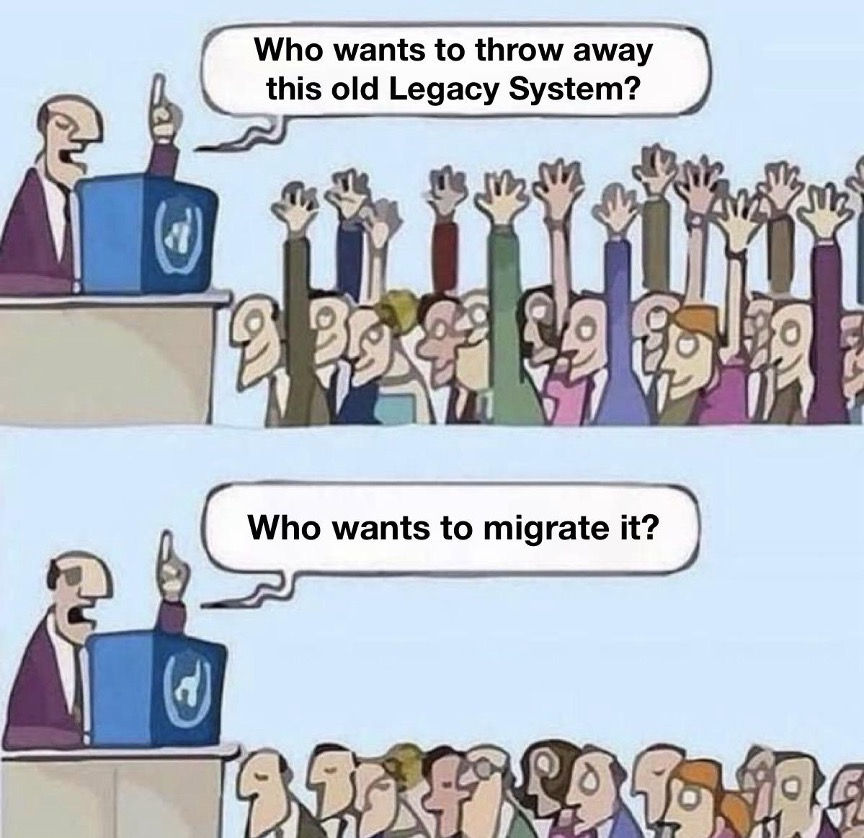
This is the messy middle of AI adoption. These legacy systems hold enormous amounts of institutional knowledge and operational data. Workers spend significant time navigating them: pulling reports, syncing data between systems, updating records manually. It is exactly the kind of repetitive, high-volume work that AI should excel at. But the systems were never designed for AI integration.
The data on this friction is stark. Deloitte's Tech Trends 2026 research found that 60% of AI leaders identify legacy system integration as their primary barrier to agentic AI implementation, not skills, not budget, but integration. McKinsey's analysis found that integration challenges account for approximately 60% of failed AI implementations in businesses with established ERP infrastructure. The Cisco AI Readiness Report revealed that 92% of enterprises are still not ready for AI deployment, with data quality and system fragmentation as the primary bottleneck. And RAND Corporation research shows that over 80% of AI projects fail to reach meaningful production, twice the failure rate of non-AI technology projects.
Solutions like autonomous setup tools work well on greenfield projects. But most enterprise users inherit brownfield environments. They are not building new systems; they are trying to make decades-old infrastructure smarter. The solution path is not wholesale replacement but strategic modularization, wrapping legacy systems with modern APIs, deploying microservices architectures that insert AI capabilities into existing workflows without requiring those systems to be rebuilt.
This problem will be solved, perhaps not through screen-clicking computer-use agents, but through something more systemic: AI that can map, understand, and operate within existing system architectures. But even when it does, we are still in the realm of reactive work. Every phase up to this point follows the same fundamental pattern: a human identifies a need, and AI fulfills it.
Phase Five: Proactive AI, and the Question of Power
The true next step is proactive work from AI. Not AI that waits for you to ask a question, but AI that notices a problem before it becomes visible to any human, develops a solution, and then asks for your permission to implement it. Depending on how much control you want to hand over, it might be one where the problem is already solved by the time you wake up to go to work.
This is not speculative. Gartner predicts that by 2028, 33% of enterprise software applications will embed agentic AI capabilities, up from less than 1% in 2024, and that 15% of daily work decisions will be made autonomously by agentic AI. Enterprise applications integrated with task-specific agents are projected to jump from less than 5% in 2025 to 40% by end of 2026. Enterprises now deploy an average of 12 AI agents, with that number expected to grow 67% within two years. But here is the challenge: 86% of IT leaders worry agents could add complexity rather than value without stronger integration frameworks, and only 54% of organizations have centralized governance for AI capabilities.
This is a fundamentally different paradigm, and it carries implications that most organizations have not begun to grapple with.
Consider how work flows in most companies today. A CEO sets a strategic direction. That direction gets translated by SVPs and VPs into operational priorities. Directors and managers further translate those priorities into team-level tasks. The information and decision flow is almost entirely top-down. Even in organizations that pride themselves on flat hierarchies, the default pattern is that strategic context originates at the top and execution happens at the bottom. But if eventually we outsourced many of the tasks to the “bees” and they become smarter and smarter, that means the “bees” are continuously monitoring operations, customer behavior, supply chain signals, financial patterns, and competitive movements will inevitably identify issues and opportunities that no individual human, at any level, could spot.

Going back to the bee versus beekeeper differentiation, this is when the bees become smarter than the beekeeper. This does not mean the beekeeper becomes obsolete. It means the beekeeper's value shifts. The role moves from "I have to execute tasks" to "I can judge which of the AI's proactive suggestions align with our values, our risk appetite, and our long-term positioning." The beekeeper becomes the taste-maker. The one who can distinguish between a pattern that represents a genuine problem and one that is noise. Between a recommendation that is technically optimal and one that is culturally wrong for the organization right now.
Will work one day in the future become a big button that a human presses to keep things going? If you look at the way we vibe code today, it certainly feels like it. We only intervene when something is off. For a great majority of the time, we are watching the AI produce the work. So far, most work start with a mandate that the humans give, but when will have a day where the AI just starts solving problems and producing work autonomously?
Until that day comes, I will savor every bit of human work I have for now.
Sharon Gai is an AI transformation strategist, keynote speaker, and former Alibaba executive. She advises Fortune 500 companies on AI adoption and organizational change, and is the author of How to Do More with Less Using AI.
Comments